August Is When We Recalibrate
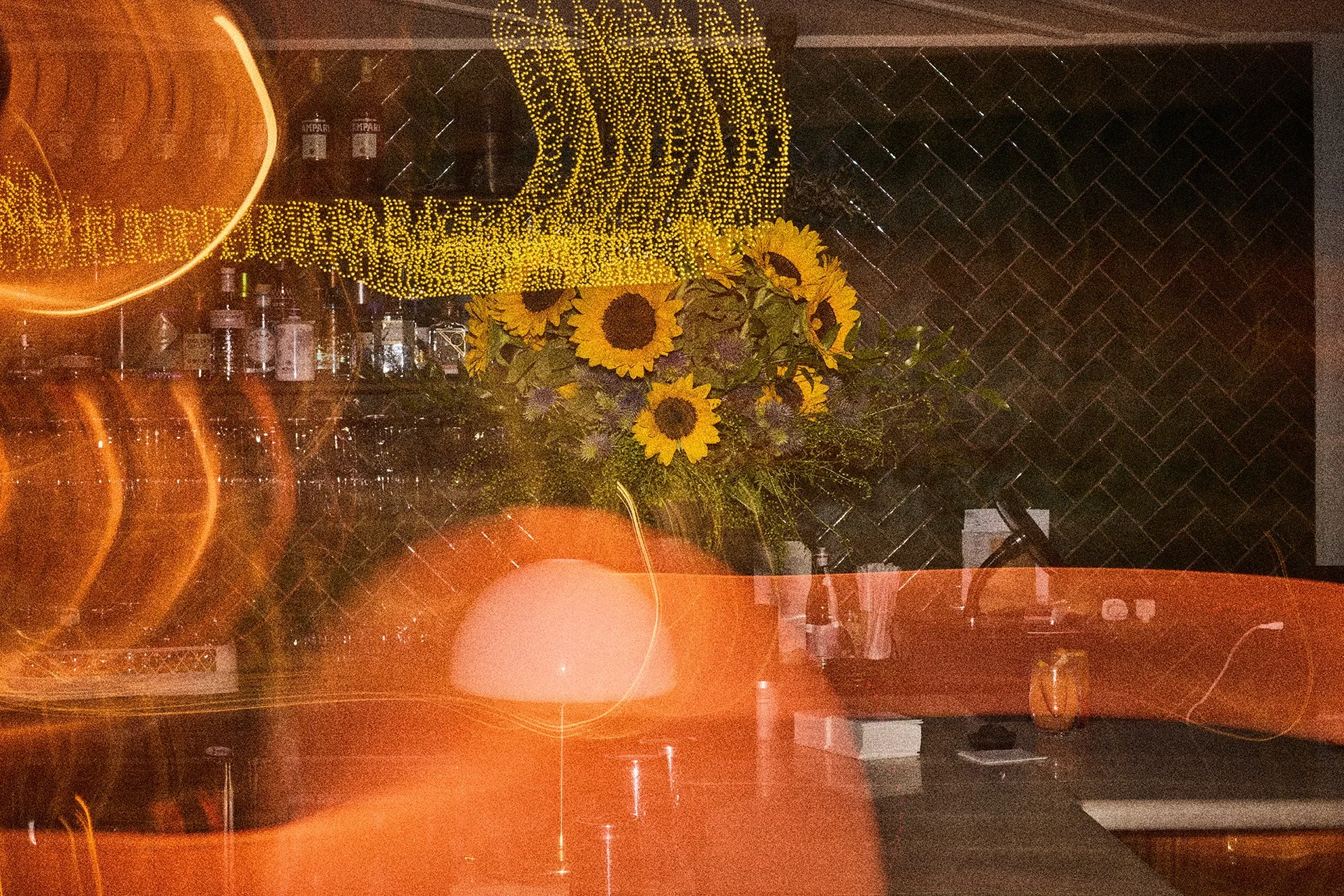
The bar at Bottega Amaro captured during a late summer evening
Every August the world rearranges itself.
Cities empty in one direction and fill in another. The people who normally sit at the next table are somewhere else entirely, queuing outside a bakery in a town they had never heard of in March.
We stay open through it. We close three days in August and no more, which means we spend the month watching the room turn over: familiar faces away, new ones in from somewhere else, everybody comparing.
Because August isn't really the month of escape. It's the month of comparison.
Whoever is doing the travelling, our guests, our chefs on their days off, the suppliers who shut for a fortnight while we don't, the pattern is the same. You sit in cafés that have served the same street for forty years. You eat in restaurants that feel no obligation to reinvent themselves every season. Then you come home. What's changed isn't where you went. It's what you now expect.
All of us come home harder to impress
There was a time when travelling meant finding things you couldn't get at home: an unfamiliar ingredient, a style of cooking, a bottle you couldn't buy anywhere else. Most of that has been flattened. Almost anything can be sourced now.
What still can't be shipped is conviction.
The bakery that makes six things rather than sixty. The restaurant that knows exactly what belongs on its menu, and more importantly what doesn't. The café that has become part of the daily rhythm of its street, rather than a destination for people who don't live on it.
Nobody articulates this at the time. You don't notice the lighting, the acoustics, the gap between tables, the hundred small decisions sitting behind what looks like an effortless service. But you feel the result. And after two weeks in enough good rooms, you come back considerably better at spotting a room that doesn't work.
That is the standard our new season will be measured against, and it starts at the end of this month, not in September. Tell us how we did. The people who know us best always have.
Restraint is a strategy, not a shortage of ideas
The industry spends most of its time talking about what's new. New openings, new menus, new concepts, new formats. Travel tends to argue the opposite case: the places worth admiring usually got good by refusing to keep becoming something else. They refine. They don't reinvent.
Our own history is the example we know best.
The reference points we pinned to the wall when Bottega Amaro was drawn up in 2016 are not the ones we look at now. The room has grown up, and the way it looks and feels has moved with the decade. But the thing underneath has never changed: a table run the way you run one for friends and family. Just the feeling, when you walk in, that somebody was expecting you.
That is what travel is actually for. Not copying a dish. Understanding why a room works.
Restraint is also easier to describe than to run. It depends entirely on the people we buy from, sending the same thing, at the same standard, every week of the year, which is why our supplier list changes considerably less often than our specials.
More choice isn't more generosity. More design isn't more atmosphere. Most of the time, knowing what to leave out is the most confident decision on the table.
One thing we've been thinking about
We have spent a good part of this summer thinking about fish. Not a new dish, and not a menu we are ready to describe yet. More a question about what a restaurant on this island should be doing with what comes out of the water around it, and how little needs to be done to it when it arrives in the right condition.
It has meant a lot of conversations with people who get up considerably earlier than we do. Some of it will reach the table when the season turns. The rest will take longer, and we would rather it did.
A city shows itself at street level
This is why cafés, neighbourhood bakeries and restaurants tell you more about a place than anything on a curated list. They are where a city's habits are visible. What time it genuinely wakes up. How long it allows for lunch. Whether it's comfortable eating alone. Whether being a regular earns you anything, or whether you are simply another cover to be turned.
You learn more about a city standing in a queue at half past seven in the morning than across a three-hour tasting menu.
What we bring back
The question was never what can we copy. Almost nothing transfers cleanly: a concept that works on one street in Paris will die quietly on the wrong street in Nicosia. The question worth carrying home is why did that place work. The answer is usually unglamorous. Clarity, consistency, and a business that understands its neighbourhood and its reason for being there.
Hospitality is the hard work required to make other people's evenings feel easy. Most of the world spends August on the other side of that arrangement. We spend it open, taking notes, and getting the next season ready.
It begins at the end of the month. Come in and tell us where you have been. Some of the better decisions we have made started life as somebody's holiday recommendation, a guest's as often as a chef's.